 Code, Noted
Leadership
The homelab argument
The strongest case for running servers in a closet has nothing to do with the servers. A long essay on small systems as professional education.
Code, Noted5 min readLeadership
There is a genre of engineering writing that never makes the conference circuit and quietly teaches more than most talks that do: the homelab write-up. An engineer describes the small cluster in their closet, the choices made, the failures survived, and the reader is invited to smile at the earnestness of running enterprise patterns for a household of four. The smile is a mistake. This essay is about why.
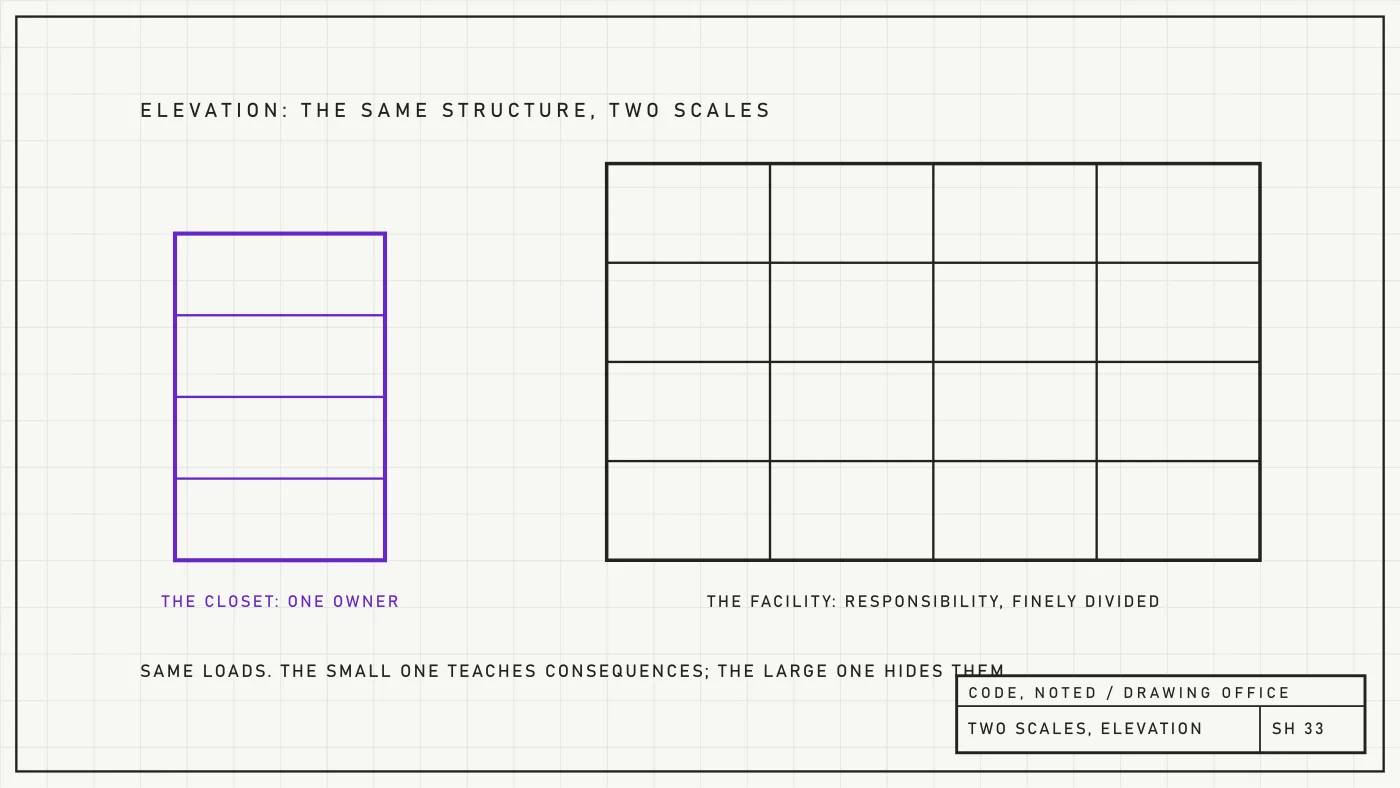
Begin with what a homelab actually is, stripped of the hobbyist framing. It is a complete system owned end to end by one person: hardware, network, storage, orchestration, backup, monitoring, upgrade policy, and the consequences. That last noun is the important one. The industry has spent twenty years subdividing operational knowledge into specialties, with the result that most working engineers have never once held an entire system's consequences in their own hands. The platform team owns the cluster, the SRE owns the alerts, the vendor owns the control plane, and responsibility, divided finely enough, approaches zero everywhere. A homelab is the antidote in its smallest commercial form: nothing about it is anyone else's problem.
Consider what its owner learns that the specialized engineer does not. Capacity, as a felt quantity: when the node has eight gigabytes, the difference between a 500 and 800 megabyte control plane is not an abstraction in a vendor's pricing tier but a question of which services fit. Failure, as a personal experience: the certificate that expires at midnight expires on the owner, and the lesson about automation arrives with the force of a cold shower rather than a postmortem slide. Upgrades, as a discipline: the homelab operator who breaks the cluster on a Saturday learns, permanently, why change windows and rollback paths exist, a lesson that a decade of change advisory boards teaches only as paperwork.
A concrete specimen is useful, and a good one is the five-node k3s homelab cluster build: a consultant's household cluster, written up with the reasoning attached, the kind of document where the technology choices matter less than the visible habit of choosing deliberately at every layer. Read it as a professional artifact rather than a hobby report and its genre becomes clear: this is architecture practice, performed at a scale where mistakes are affordable and therefore actually made, survived and understood.
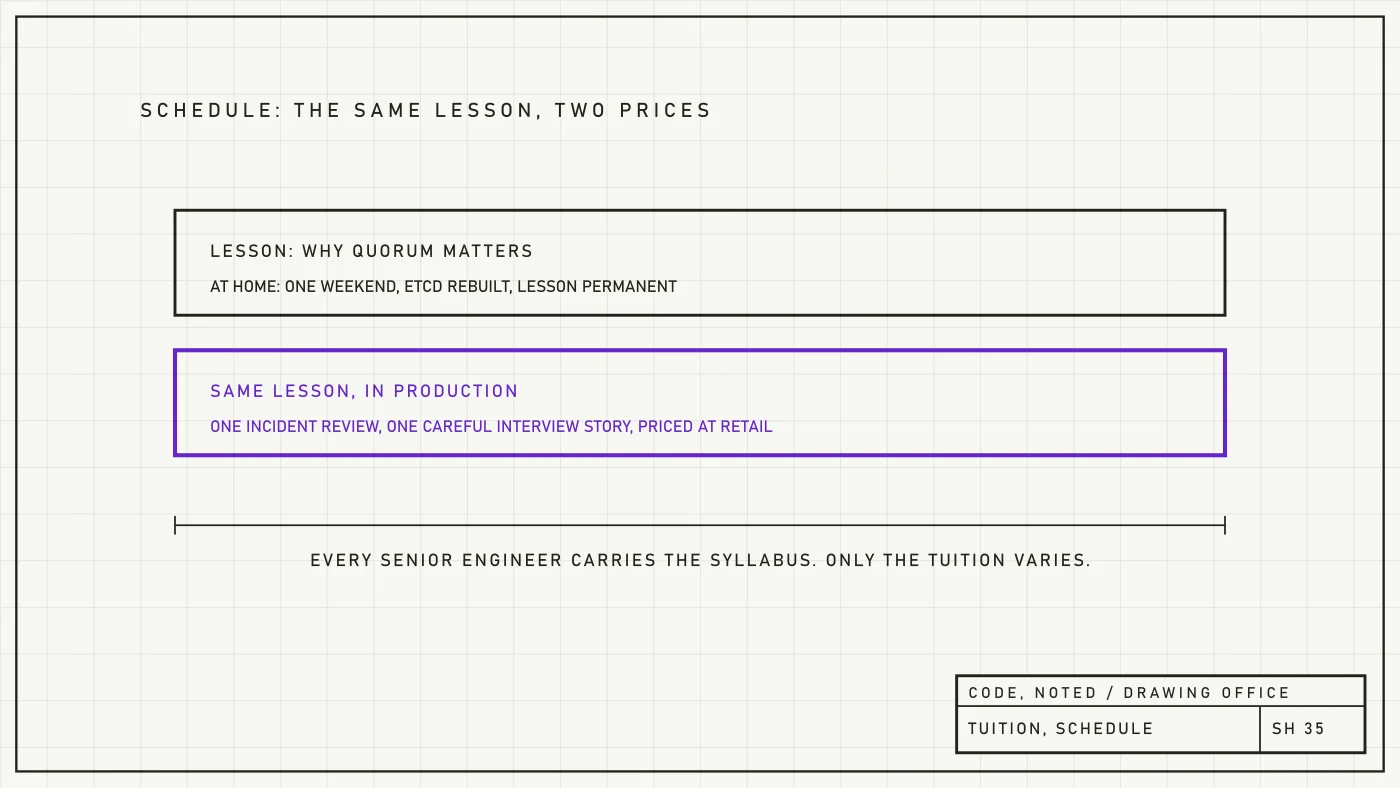
That affordability deserves a longer look, because it is the economic heart of the argument. In production, the cost of a lesson is proportional to the blast radius, which is why mature organizations correctly build guardrails that prevent engineers from learning anything interesting by accident. The guardrails are right and their side effect is real: the modern engineer can spend five years at a well-run company without once seeing a system die of their own decision. The homelab reprices the tuition. Etcd corruption at home costs a weekend and teaches quorum forever; the same lesson in production costs a career story one tells carefully in interviews. Every senior engineer carries a private syllabus of disasters; the homelab is the only place the syllabus can be acquired at a discount.
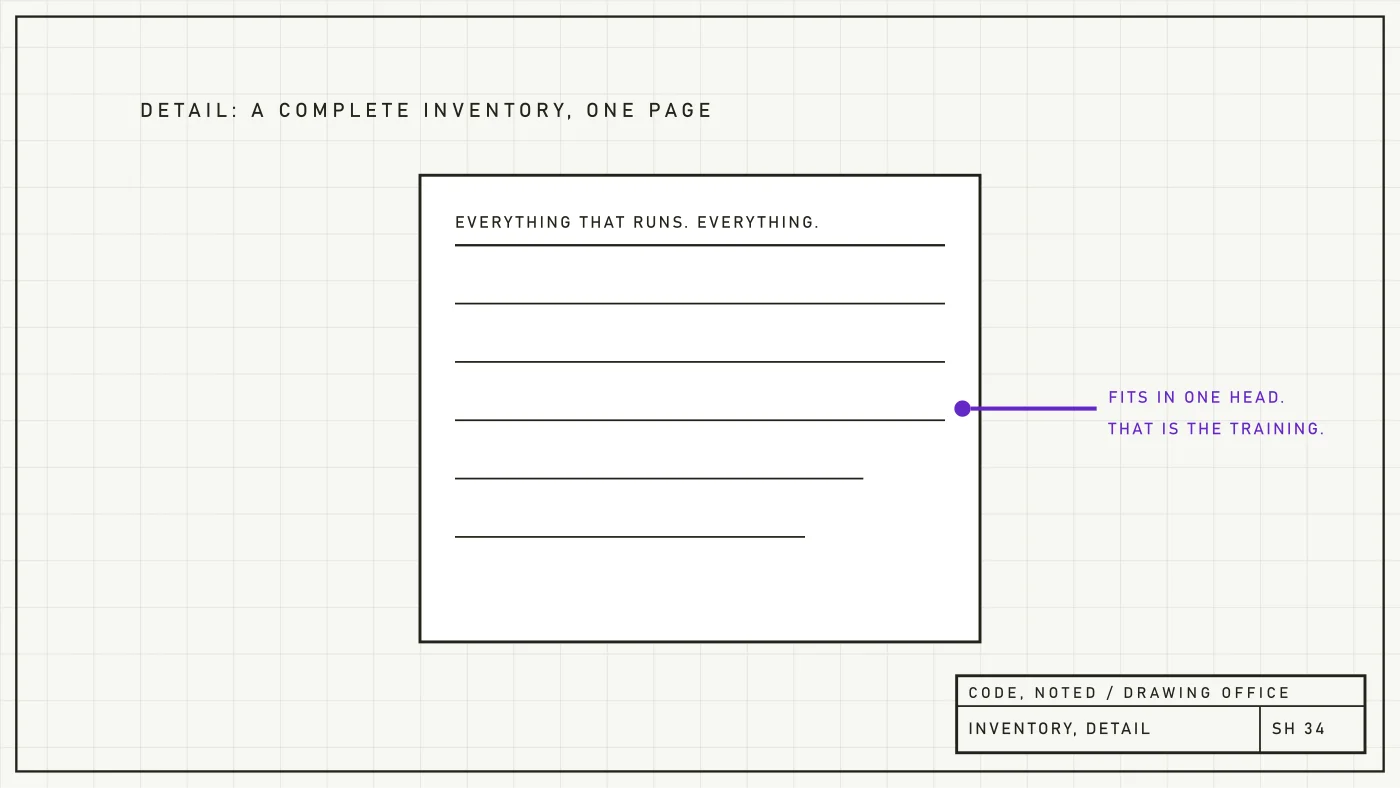
There is a second, stranger benefit, one the write-ups demonstrate more than they state. A small system fully understood recalibrates an engineer's tolerance for unexplained complexity in large ones. The homelab operator knows what a complete inventory feels like, because theirs fits on one page. They know what it is to have read every config line that matters. Returned to the enterprise estate, that engineer asks a question the specialists have stopped asking: why is this part here, and who understands it? The question sounds naive. It is the beginning of every good architecture review we have ever read, and the reviewers who ask it most naturally are, in our observation, disproportionately people who run something whole at home.
The objections deserve their paragraph, because the argument is easy to overclaim. A homelab is not production experience: it has no adversarial traffic, no compliance regime, no colleague whose deploy collides with yours, no organizational physics, and the engineer who generalizes from four users to four million has learned the wrong lesson entirely. Scale changes kind, not just degree; nothing in a closet teaches what a thundering herd does to a connection pool. And the hobby has its own pathology, familiar from every field with equipment: the operator who rebuilds the cluster monthly is practicing acquisition, not operations. The write-ups worth reading are the ones where the system is boring and stays up, because boring-and-up is the skill.
With the caveats filed, the institutional conclusion follows anyway, and it is more practical than sentimental. When hiring, treat a documented homelab the way one treats open-source contributions: not as a requirement (the parent of small children with no closet servers is not a lesser engineer) but as evidence of a specific and valuable appetite, the appetite for consequences. When developing staff, notice that the cheapest systems-thinking training available is often not a course but a sandbox with real stakes: a team lab, a production-shaped environment someone actually owns overnight. And when reading, add the homelab write-up to the professional syllabus beside the incident report, its optimistic twin: one documents how systems die, the other how they are kept alive by one attentive person, and both are more honest than anything with a marketing review.
The servers in the closet were never the point. The point is the shape of the person who keeps them running: someone who has held an entire system in their head, paid for their own mistakes at retail, and come back for more. Enterprises are built out of people, and the ones who have run something whole, at any scale, are the ones who can be trusted with a piece of something vast. The closet is small. The habit is not.