 Code, Noted
Delivery
DevOps, fifteen years on
The word conquered the industry and dissolved into it. An audit of what the movement actually changed, what it renamed, and what it quietly gave up.
Code, Noted2 min readDelivery
Movements in software have a lifecycle: manifesto, conference, job title, backlash, dissolution into the water supply. DevOps has completed the arc. Nobody argues for it anymore because nobody argues against it; the word survives mainly in job postings, where it means "operations, but the org read a book once." Fifteen-odd years on from the first DevOpsDays, an audit seems fair: what changed, what merely changed names, what got lost.
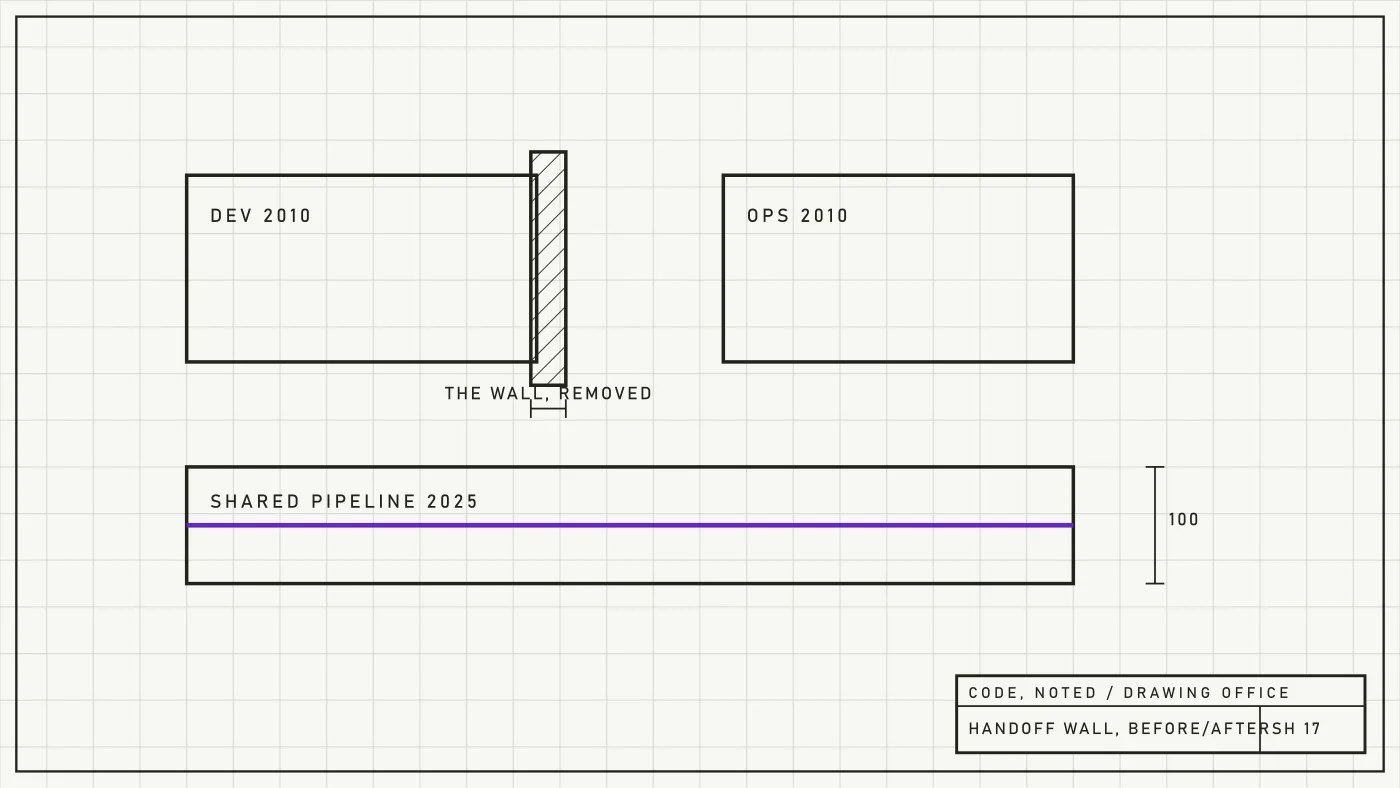
What changed is real and worth defending against cynicism. The wall is gone: the ticket-over-the-fence handoff from developers to a separate operations department is now a diagnostic of organizational illness rather than the default shape of the industry. Deployment went from quarterly ceremony to a boring, frequent non-event in every shop that wanted it to. Infrastructure became code, reviewable and versioned. And the movement got its measurement program: the DORA research, running annually since 2014, gave the industry evidence that speed and stability correlate, which quietly ended a decade of "we can be fast or careful, pick one."
What changed names is a longer list. The separate ops team became the separate platform team, the separate SRE team, the separate "DevOps team," an inversion of the founding idea so common it became the movement's running joke. Runbooks became "operational excellence wikis." The config management wars produced winners, then the winners were abstracted behind YAML that no one would call progress with a straight face. Renaming is not nothing (vocabulary carries norms), but it should not be invoiced as transformation.
What got lost is the interesting entry. The original movement had two halves: automation, and a culture argument about shared ownership, humane on-call, blameless learning. The automation half won totally, because tools can be purchased. The culture half won partially and unevenly, because it cannot. Plenty of organizations today run world-class pipelines around unchanged trust structures: deploys are continuous, but a failed one still launches a hunt for the responsible name; the pager's signal still routes to HR instead of architecture. The movement's tooling made their old culture faster.
There is also an unpaid bill the founders would recognize: the complexity budget. DevOps promised that owning your operations would keep systems honest ("you build it, you run it" was a feedback loop, not a slogan). In practice, ownership was often mediated through platforms of such depth that a 2010 sysadmin would recognize the ops work instantly; it just wears a different YAML now. The feedback loop works where teams genuinely feel their operational choices. Where the platform absorbs all consequences, the loop is open again, and open loops grow the same old moulds.
Fifteen years is long enough to say what DevOps was: not a technology wave but a settlement, renegotiating who carries the consequences of software after it ships. Settlements need maintenance like any standing system. The organizations still extracting value from the word are the ones that kept the uncomfortable half of the bargain, and would keep it under any name at all.