 Code, Noted
Delivery
In praise of boring deploys
The most sophisticated thing a delivery pipeline can be is uninteresting. On boredom as an engineering achievement with a bill of materials.
Code, Noted2 min readDelivery
There is a class of engineering achievement that announces itself by the absence of sensation, and the boring deploy is its purest member. Code moves to production; nothing is felt; nobody gathers; the author checks a dashboard out of habit rather than fear. Teams that have this treat it as weather. Teams that lack it treat deploys as weather too, in the other sense: events to be forecast, dreaded and survived.
Boredom of this kind is manufactured, and the bill of materials is knowable. Small batches, because a deploy carrying one change has one suspect when something drifts, a point the release-train essay belabors. Reversibility, because rollback that takes one minute converts "incident" into "blip," and the knowledge that reverting is cheap changes how people ship in the first place. Flags to separate deploy from release, so that moving code and exposing behavior stop being the same terrifying instant. And observability sharp enough that the system announces its own distress before a customer volunteers to.
Dan McKinley's choose boring technology argument supplied the adjacent doctrine a decade ago: innovation tokens are scarce, so spend them on the product, not the plumbing. The deploy pipeline is the plumbing's plumbing. Every clever thing in it (the bespoke orchestrator, the deployment DSL only its author loves) is a token spent making Tuesdays interesting, which is the wrong place for interest to live.
The praise needs its honest boundary: boring is a property you buy for a context, not a universal entitlement. A mobile app gated by store review, firmware in the field, a database engine's storage layer: these have release physics that no pipeline abolishes, and pretending otherwise produces cargo-cult continuous delivery, ceremony without the physics. Even there, though, the gradient points the same direction; the achievable boredom is worth buying, and the teams that ship phones and firmware well are precisely the ones that made everything before the gate uneventful.
What makes the subject worth an essay rather than a checklist is the second-order effect. Deploy fear is a tax on honesty. Where shipping is an event, fixes wait for the next train, workarounds accrete, and the gap between the code that exists and the code that runs becomes a place where knowledge goes to be wrong. Where shipping is boring, the truth moves to production continuously, in increments small enough to reason about. The pipeline is not really the point. The epistemics are the point; the DORA findings that speed and stability travel together stop being surprising the moment one sees small, boring, reversible change as an information policy rather than a velocity play.
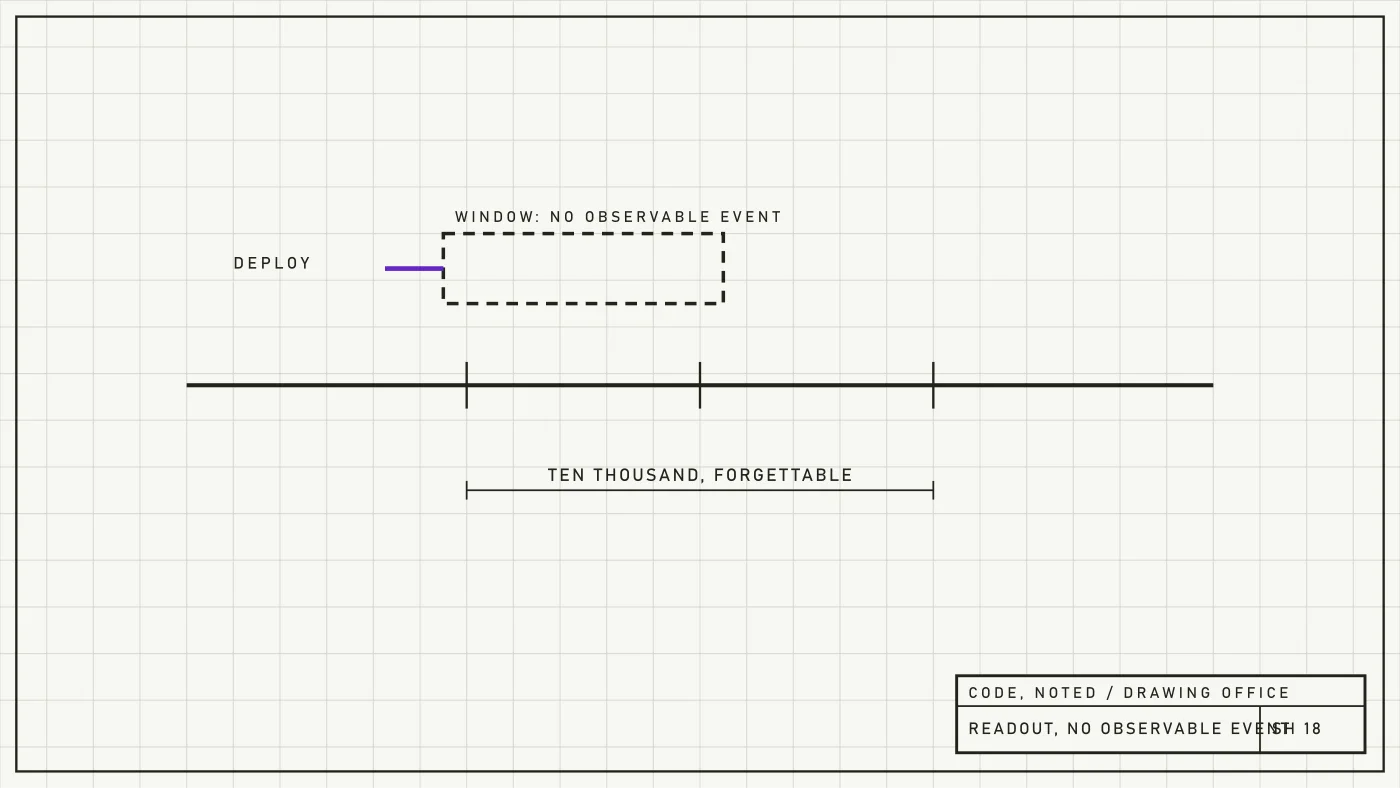
The craft ideal hiding in all this is old, and other trades know it: the mark of mastery is that the difficult looks routine. Anyone can make a deployment dramatic. Making ten thousand of them forgettable is the work of years, and the practitioners who did it deserve the strange compliment their systems earn. Nothing happened, again, all year. Five stars.