 Code, Noted
Delivery
The upgrade nobody rushes
Postgres 18 shipped in September to the usual absence of panic. On release discipline as an institution, and what the calmest corner of infrastructure teaches.
Code, Noted3 min readDelivery
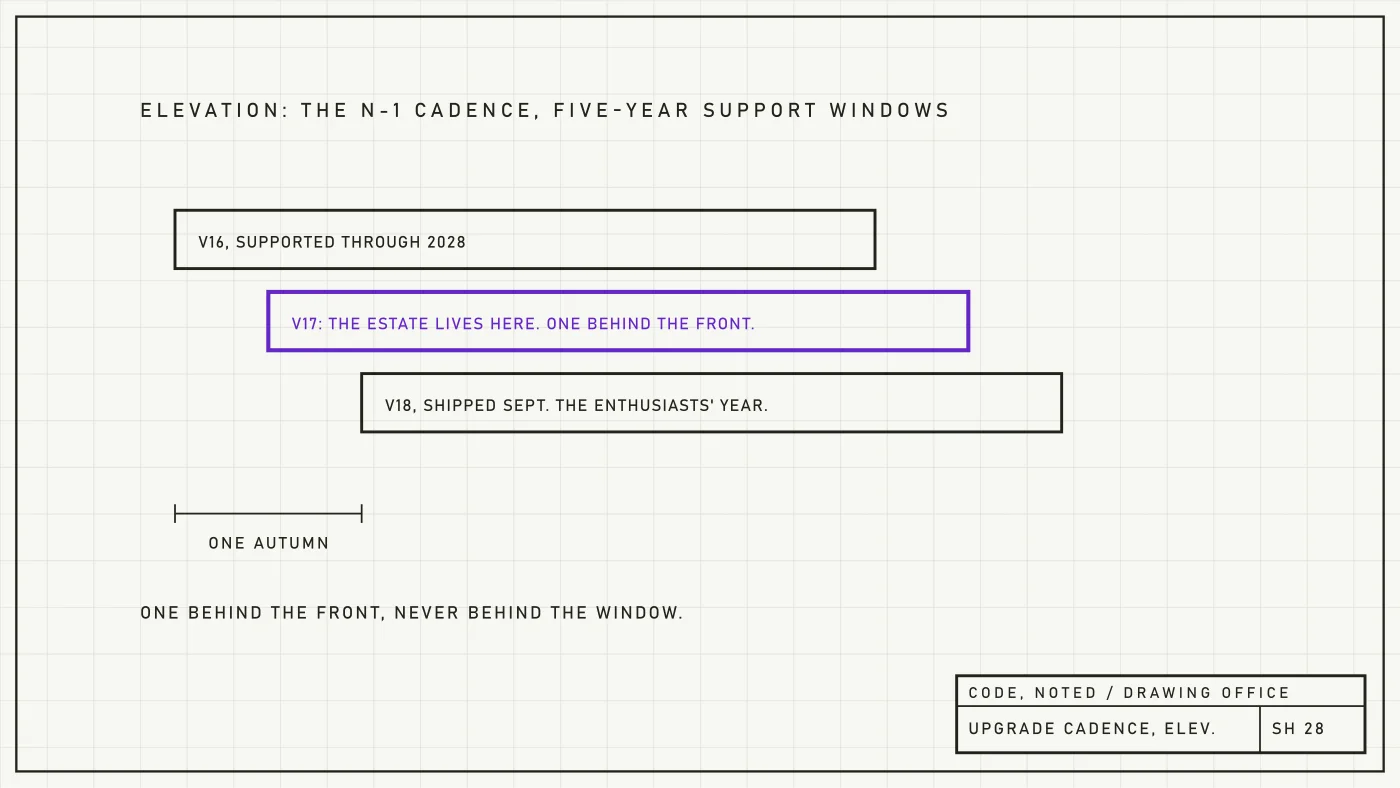
PostgreSQL 18 shipped in September, and the estates of the world responded with their traditional composure: they did not install it. They will not install it this quarter, most of them, and the project's own versioning policy is built on the assumption that this is fine. Five years of support per major version; a predictable annual cadence; a community that treats the .0 release as an artifact for the enthusiastic. The result is the calmest upgrade culture in infrastructure, and calm, examined closely, turns out to be a designed property rather than a temperament.
It is worth taking the design apart, because most of the industry runs the opposite culture and calls it velocity.
The first component is the contract of dates. Postgres majors arrive every autumn and die on schedule five years later. Nothing about an individual release is urgent, because urgency has been moved into the calendar itself: everyone knows, years ahead, when version N leaves support, and the estate can plan its crossing in whichever year suits its risk appetite. Compare the ecosystems where releases arrive when ready and deprecations arrive by surprise; their operators live in a permanent low-grade present tense, and their upgrade projects are always emergencies wearing project plans. Predictability is not a feature of the software. It is a feature of the promise, and promises are architecture.
The second component is the N-1 discipline as a social norm rather than a written rule. The received practice, run one major behind, let the .1 and .2 releases catch what the .0 shook loose, is nowhere an official recommendation. It is folklore, in the strict sense: knowledge held collectively, transmitted by apprenticeship, and more binding than policy because nobody has to enforce it. An organization can write "we upgrade conservatively" in a standard and be ignored; a community that simply behaves that way, visibly, in public lists and conference talks, teaches the behavior to every newcomer for free. Culture is the cheapest compliance regime ever devised.
The third component is what the calm purchases. A database upgrade deferred a year is not procrastination; it is a year of other people's production traffic spent hardening the release, a year of extension authors catching up, a year of blog posts about the sharp edges written at someone else's expense. The conservative upgrader is a free rider, in the honorable sense, on the enthusiasm of others, and the system works because the enthusiasts are also real: the managed-service providers and the performance-hungry, upgrading early for their own reasons, generating the evidence the cautious majority waits for. The ecosystem has, without anyone designing it, an immune response staged in rings, which is precisely what the July 2024 endpoint disaster taught everyone to want, achieved here by temperament alone.
There is an argument on the other side, and in fairness it has teeth. The N-1 habit can decay into N-2, then into "the version the vendor no longer patches", and the same calm that makes Postgres estates stable makes their laggards invisible; nobody pages you for running 13 in its final supported year. The discipline only works with the second half attached: one behind the front, never behind the support window, and the crossing scheduled, in writing, the day the window's end date is published. Calm without the calendar is just neglect with better posture.
The generalization, since this essay is only nominally about a database. Any team that owns a platform, an internal framework, an API consumed by strangers, is choosing, whether it knows it or not, between the two cultures on display here: urgency managed by calendar, or urgency delivered by surprise. The first costs a promise and buys a decade of quiet. The second is free and bills monthly. Postgres 18's arrival, greeted by an industry checking its diary rather than its pager, is what the first choice looks like eighteen releases in. It is the least dramatic success story in infrastructure, which is, of course, the entire point.