 Code, Noted
Delivery
Feature-freeze archaeology
A change freeze is an accidental experiment. What the exemption list, filed in order of arrival, reveals about an organization's real architecture.
Code, Noted2 min readDelivery
Every large organization eventually declares a change freeze: before the peak season, before the audit, before the migration. The freeze is announced as a control. It functions, whether anyone intends this, as an experiment, and the results are filed in a document nobody studies afterward: the exemption list.
Read one sometime. Read it the way an archaeologist reads a midden, as the honest record of what a settlement actually consumed. The official architecture says the estate is composed of systems A through K, decoupled, independently deployable. The exemption list says otherwise. It says the pricing table changes twice a week no matter what the calendar declares. It says the "static" reference data has a heartbeat. It says four teams believe, with supporting paperwork, that their system is the exception the freeze was not meant for.
Each exemption is a coupling the diagrams omit. A system that cannot go two weeks without change is coupled to something that moves: a market, a regulator, an upstream feed, an executive's dashboard. None of those couplings appear in the architecture review, because architecture reviews examine what talks to what, and these are couplings of tempo. The freeze finds them in fourteen days, which is faster than any dependency-mapping tool the organization has purchased.
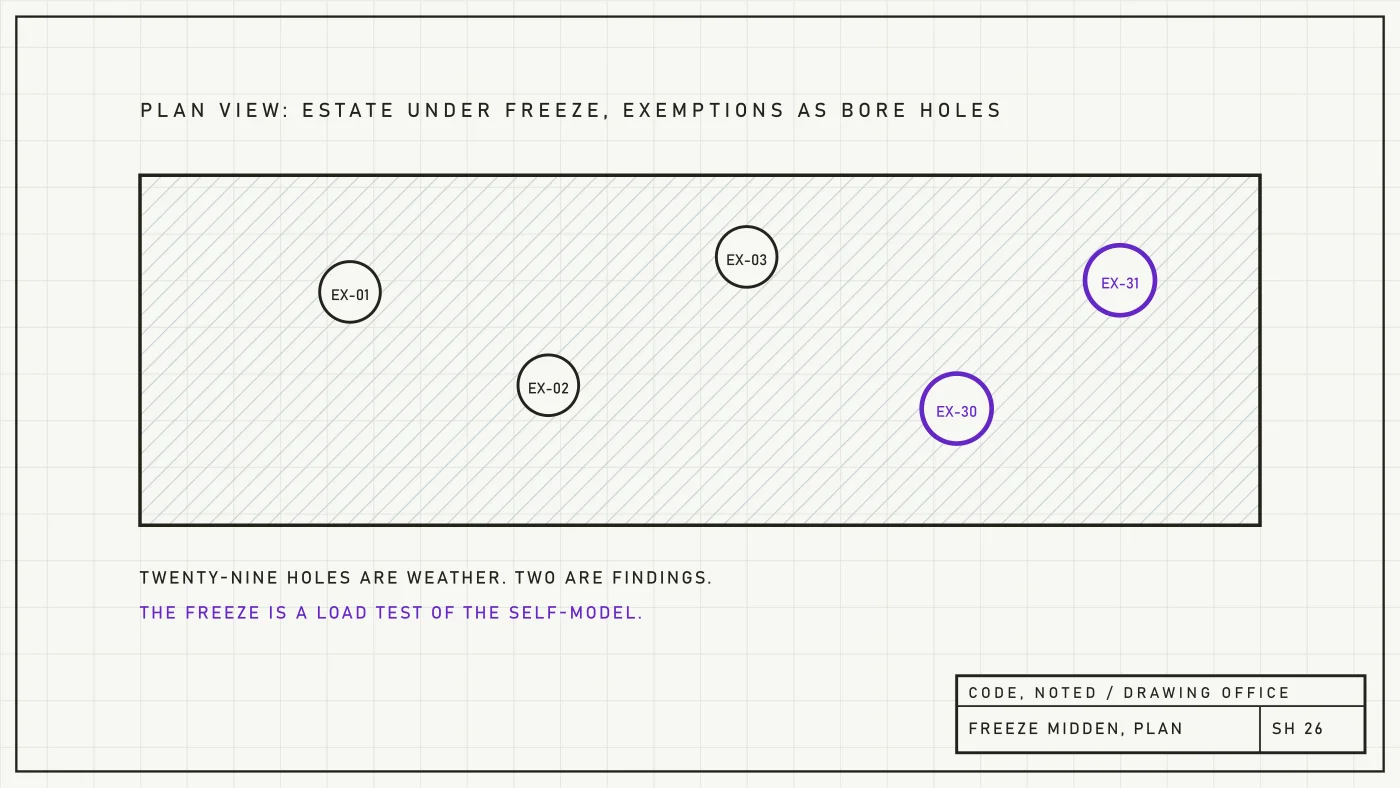
The first freeze I watched closely, years ago at an insurer, produced thirty-one exemption requests. Twenty-nine were the ordinary weather of a living business. The remaining two were the finding: a batch job whose "configuration" was hand-edited SQL, and a vendor integration whose certificates expired on a schedule nobody controlled. Both had appeared on the diagrams as arrows, thin and unlabeled. Both later justified projects. The freeze had functioned as a load test of the organization's own self-model, and the self-model failed in two places, cheaply, on a schedule.
So the modest proposal: treat every freeze as paid-for research. When it ends, spend one afternoon on the exemption list with the architecture group present. Sort the exemptions into weather and findings. The weather calibrates the next freeze's scope, because a freeze with predictable exemptions should simply exclude them and mean the rest. The findings go on the technical-debt register with the evidence already attached: this system, on this date, could not hold still for two weeks, and here is what it was coupled to.
Organizations pay consultancies handsome sums to discover their real dependencies. The freeze discovers them for free, twice a year, and the results are thrown away with the thaw. Keep the midden. It knows things.