 Code, Noted
Architecture
The update that stopped the world, read as architecture
Nearly a year after the CrowdStrike outage grounded flights and closed hospitals, the postmortems have settled. The architectural reading has not.
Code, Noted3 min readArchitecture
On July 19, 2024, a malformed content update to a widely deployed security agent rendered some 8.5 million Windows machines unbootable inside an hour. Flights grounded, surgeries postponed, broadcasters dark, and a fair fraction of the world's checkout lanes silent. As the anniversary approaches, the incident retrospectives have hardened into received wisdom about testing and deployment hygiene. The received wisdom is fine. It is also the smaller half of the lesson.
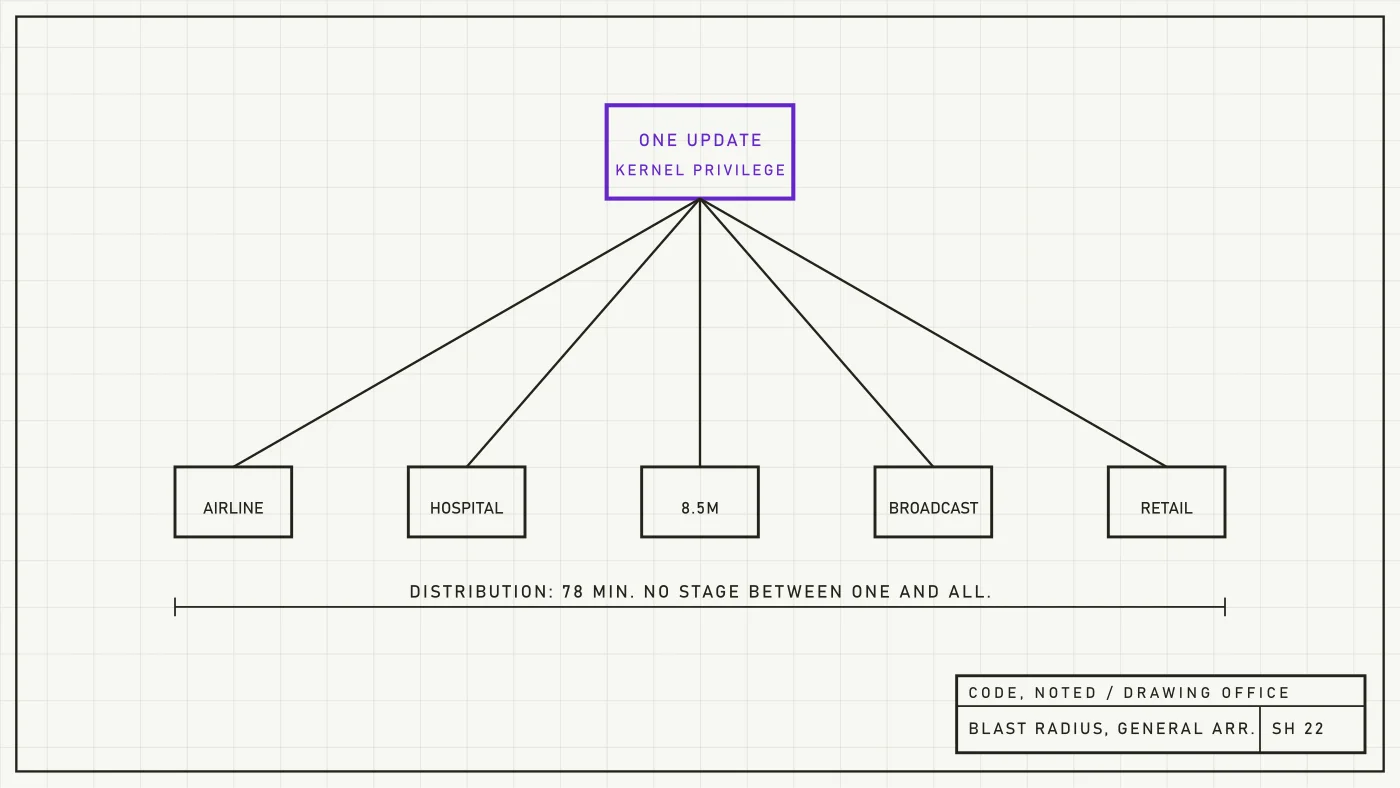
Begin with definitions, because the words did a lot of quiet work in the aftermath. The failing artifact was not, in the vendor's vocabulary, software: it was a "content" update, configuration data consumed by an already-installed driver. This distinction mattered enormously to the change-control regimes of the affected enterprises, which gated software updates through staging rings and waved configuration through as data. The machines did not observe the distinction. Anything that alters the behavior of code running at kernel privilege is a deployment, whatever the change-advisory board calls it, and the first architectural reading of the incident is simply that taxonomies are load-bearing. Files do not care what committee approved them.
The second reading concerns where the failure sat. The agent ran in the operating system's kernel, the one place from which a fault cannot be contained, because that is where the product's value proposition lived: security software sells depth of access. Every enterprise that bought it accepted, mostly without writing it down, a component with maximal blast radius and an update cadence measured in hours. History rhymes here. The industry spent the 2000s learning to distrust kernel drivers from hardware vendors, built signing regimes around them, and then granted a fleet-wide exception to the category of software whose job was distrust itself.
The third reading is the one boards found genuinely new: the monoculture arithmetic. A security agent on 70 percent of your fleet is not a 70 percent risk; it is a single point of failure with a marketing department. Diversity of suppliers, the boring old counsel of procurement, turns out to be an availability control, and the enterprises that recovered fastest that July were disproportionately the ones whose estates were, by accident or stinginess, mixed. Nobody had claimed the homogeneity on a risk register. Concentration risk had been filed under "standardization benefits", where it always hides.
What, then, does the architectural reading recommend, one year on?
Treat privileged third-party agents as what they are: the highest change-velocity components in the estate running at the highest privilege. That combination deserves its own review, annually, with the vendor's rollout controls in scope. The affected vendor now offers the staged deployment rings it lacked; the pointed question for every other agent vendor is whether they built theirs before or after a customer became a news cycle.
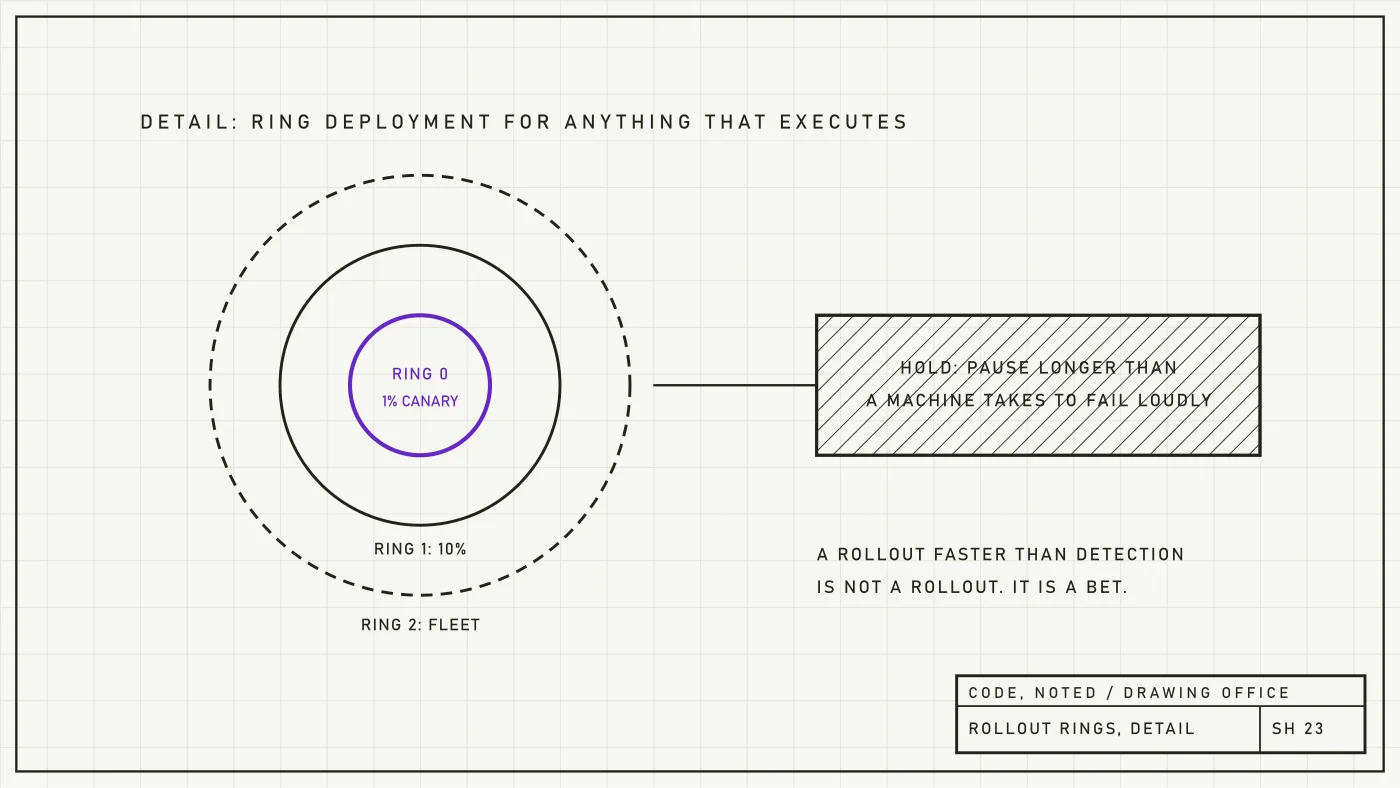
Demand ring deployment for everything that can execute, including things labeled content. One percent of the fleet, then ten, then the rest, with a pause long enough for a machine to fail loudly. The July incident's cruelest detail was its speed: global distribution in under an hour and a half, which is to say, faster than any human process could notice, decide and stop. A rollout faster than your detection is not a rollout. It is a bet.
And rehearse the recovery path for the machine that cannot boot. The remediation that July required hands on keyboards, in some enterprises tens of thousands of times, because the fleet's recovery tooling assumed the operating system would be present to help. Recovery plans inherit assumptions from sunny weather. The one assumption worth deleting is that the machine will be able to participate in its own rescue.
The counterargument deserves its hearing: security agents stop real attacks daily, and the cure for one bad update is not fewer defenses. Quite so. Nothing here argues for less protection. It argues that protection is infrastructure, and infrastructure earns engineering controls rather than exemptions from them. The distinction between trusting a vendor's intentions and trusting their deployment pipeline is the whole distinction; July 2024 was a failure of the second kind, at a category of vendor the industry had been reviewing only for the first.
A year on, the enduring image is not the blue screens. It is the airport departure boards, hand-written on whiteboards by staff who discovered, that morning, which single supplier their operation actually stood on. Every estate has that supplier somewhere. The anniversary is a reasonable deadline for being able to name it.